Key Doctor Blade Questions Answered
Get expert answers to common technical questions related to doctor blade selection process. From precision roll doctoring to cleaning, doctor blades are essential for removing excess material from surfaces in industries like printing and coating. Discover the key factors to consider when selecting the appropriate blade profile for your application.
Polymer doctor blades are generally easier and safer for new operators to handle than steel blades. They have no sharp steel edge that can cut hands during changeovers, and a damaged polymer blade doesn’t shed metal slivers into the ink. TruPoint polymer blades are also engineered to minimize anilox wear, which helps while an operator is still learning to set pressure. The installation basics stay the same, though: a clean holder, a correctly seated blade, even contact at every checkpoint and the lightest pressure that gives a clean wipe.
Uneven doctor blade wear is usually caused by uneven contact with the anilox roll. The three common causes are a blade holder that is skewed or off the anilox centerline, a blade seated with ripples from overtightening, and pressure that is heavier at one end. One area of the blade then works harder and wears faster. Operators often add pressure to compensate, which hides the symptom but speeds up wear on both the blade and the roll. The fix is to re-check alignment at every contact point.
The most common signs of a badly installed doctor blade are streaks in the print, ink density that is heavier on one side, ink leaking from the ends of the chamber and a blade that wears unevenly. A glossy anilox roll after inking is another sign, because it means the blade is leaving ink behind. Each of these points back to one of the 3 keys: a damaged or rippled blade, a misaligned chamber or the wrong pressure. Check alignment at every contact point before adding pressure, since extra pressure usually hides the cause instead of fixing it.
To install a doctor blade correctly, clean the blade holder, check the blade edge for damage, and seat the blade flat with no ripples. Then engage the chamber slowly and confirm every contact point touches the anilox roll at the same time. Finish by setting the lightest pressure that gives a satin finish on the inked roll. Most installation problems come from skipping one of these checks, especially overtightening the holder or adding pressure to make up for a misaligned chamber. A one-page setup checklist keeps every operator on the same steps.
The most effective way to reduce doctor blade deflection without adding blade pressure is to switch to a blade engineered for sustained stiffness rather than compensating with force. Increasing pressure may mask deflection briefly, but it accelerates blade and anilox wear and introduces new metering inconsistencies. A better approach is selecting a reinforced blade such as TruPoint Edge or a laminated blade such as TruPoint PolyLam XL, whose constructions resist tip flexing across long, fast runs. Because the blade holds its own rigidity, you achieve stable metering at lower, gentler pressure settings. This protects the anilox roll, extends blade life, and improves repeatability between jobs. In practice, addressing deflection at the material level, choosing a blade built for long-term stiffness, solves the root cause, whereas raising pressure only treats the symptom and creates downstream problems.
Yes, modern plastic doctor blades can deliver steel-like metering stability while controlling deflection, thanks to advances in reinforced and laminated construction. Reinforced blades embed engineered fillers such as glass fibers into the polymer to resist flexing under load and maintain stiffness over long runs. Laminated blades bond multiple plastic layers around a high-strength core, improving both initial and long-term rigidity and reducing tip movement. Together these designs hold a stable metering edge at high press speeds without the drawbacks of metal. The advantage is that printers gain the rigidity needed to prevent deflection while keeping the anilox protection and operator safety that polymer blades are known for. For high-speed presses, a well-engineered plastic blade can match steel’s metering consistency without putting the anilox roll or operators at the same risk.
Doctor blade deflection and blade wear are different failure modes that are easy to confuse. Wear is the physical erosion of the blade edge over time, and it is usually visible on inspection, the edge rounds or thins. Deflection, by contrast, is the flexing or movement of the blade tip under load, and it can occur even when the blade looks completely intact. That is what makes deflection so deceptive: operators inspect for visible wear and find none, yet the press still produces color inconsistency and requires constant adjustment. Both problems hurt print quality, but they call for different solutions. Wear is addressed through blade material and edge selection, while deflection is controlled through blade stiffness, particularly long-term stiffness that holds up across extended, high-speed runs rather than softening partway through a job.
Doctor blade deflection is caused by mechanical forces at the blade-to-anilox interface that exceed the blade’s ability to stay rigid. At high press speeds, vibration, friction, and force on the blade all increase. As the anilox rotates faster, it feeds ink into the blade nip at a higher rate, and the blade must resist rising hydrodynamic pressure to shear that ink cleanly — pushing the tip to flex against the anilox roll. When the tip can no longer hold a stable position, ink metering becomes uneven. Deflection is made worse by blades that lose stiffness over the course of a run, since long, high-speed jobs demand sustained rigidity rather than just high initial stiffness. The result is color variation, inconsistent ink laydown, and frequent press adjustments. Because deflection develops gradually and leaves no visible sign on the blade itself, it often goes unnoticed while print quality slowly drifts.
While it is physically possible to run the same doctor blade specification at both white ink and CMYK process stations, it is not recommended. The operating conditions at white ink stations , abrasive TiO₂ pigment, higher-BCM anilox configurations, heavier ink film weights, and higher viscosity inks , create a wear environment that is fundamentally more demanding than process color stations. A blade that runs reliably for weeks at a cyan or black station may fail within days at the white station under these conditions. Running the same spec across all stations typically means either over-engineering the CMYK stations (adding unnecessary cost) or under-engineering the white station (accepting shortened blade life and more press stops). Most printers find that maintaining a dedicated blade specification for white ink stations reduces total pressroom cost, even accounting for the small increase in blade inventory complexity.
The anilox roll configuration at white ink stations compounds doctor blade wear beyond what TiO₂ abrasion alone would cause. White ink requires heavier ink film weights than process colors to achieve adequate substrate opacity. This means white stations typically run higher-BCM anilox rolls with larger cell volumes and more open geometries. These configurations increase blade wear because of cell geometry: larger, more open cells create more aggressive contact on every rotation. The combination of abrasive pigment, increased blade-to-anilox contact, and often higher viscosity white inks creates a wear environment that is categorically different from process color applications. This is why the anilox roll selection and the doctor blade specification at white stations should be evaluated together, not independently, when troubleshooting blade life or print consistency problems.
The best doctor blades for white ink applications in flexographic printing are reinforced or laminated polymer blades designed for high-fatigue, long-run conditions. The key requirements are wear resistance against titanium dioxide abrasion, long-term stiffness that maintains consistent blade angle and metering pressure throughout the run, and a precision-finished tip profile that reduces anilox scoring risk. Standard blade materials that perform adequately at CMYK process stations often underperform in white ink applications because they lack the structural consistency needed to withstand repeated TiO₂ contact over a long run. TruPoint PolyLam XL is engineered specifically for demanding wide web and narrow web applications, including white ink stations. Its laminated construction resists the stiffness relaxation that causes metering drift in standard blades. Printers who switch to a dedicated blade specification for their white stations typically see longer blade life, fewer press stops, and more consistent print density.
White ink wears doctor blades faster than process colors because of its primary pigment: titanium dioxide (TiO₂). Unlike the organic pigments used in cyan, magenta, yellow, and black inks, TiO₂ is a dense, insoluble mineral compound with significant abrasive properties. As white ink cycles through the chambered doctor blade system, TiO₂ particles repeatedly contact the blade edge on every rotation of the anilox roll. This continuous abrasive contact accelerates edge fatigue, loss of metering consistency, and , at higher press speeds , outright blade failure. Process color inks rely on finer, softer organic pigments that generate far less mechanical wear. The difference in wear rate between a white ink station and a CMYK process station running the same blade specification can be two to three times higher, making white ink one of the most demanding doctor blade applications in flexographic printing.
Doctor blades are used in any industrial process that requires precise metering or wiping of a fluid from a roller surface.
- In flexographic printing, doctor blades meter ink on anilox rolls to control how much ink transfers to the printing plate and substrate.
- In narrow web label printing, doctor blades manage precise ink metering at high speeds for consistent dot reproduction.
- In wide web printing, doctor blades handle high-volume ink delivery across wide-format presses.
- In corrugated packaging, doctor blades manage high ink volumes across wide-face anilox rolls under heavy press loads.
- In coating and lamination, doctor blades control the thickness of adhesives and coatings applied at high speed. In sheetfed offset printing, doctor blades meter dampening solution and specialty coatings.
- In digital printing, doctor blades control fluid application in hybrid and inkjet-assisted systems. In lithium-ion battery manufacturing, doctor blades coat electrode materials onto foil substrates with precise thickness tolerances.
TruPoint polymer doctor blades from Flexo Concepts serve all of these applications, replacing steel to eliminate anilox scoring, improve safety, and extend blade life.
Flexo Concepts offers a free doctor blade trial program that allows flexographic printers to test TruPoint polymer blades on their presses before committing to a purchase. The trial includes blade samples cut to your press specifications, technical support from a Flexo Concepts application specialist, and installation guidance to ensure proper blade angle and pressure setup.
To request a free trial, use the contact form on this page, call Flexo Concepts directly, or submit a request through the free trial page at flexoconcepts.com/free-trial. Provide your press type, current blade type and width, and your primary application (narrow web, corrugated, or coating and lamination). A Flexo Concepts representative will respond within one business day to coordinate your trial blades.
Doctor blade scoring on anilox rolls is caused by the harder metal edge of a steel blade cutting into the softer chrome or ceramic coating of the anilox roll surface. The scoring appears as fine, parallel lines running across the roll face. Once scored, the damaged cells can no longer hold their calibrated ink volume, causing inconsistent ink metering, streaks, and color variation in print.
Scoring is accelerated by excessive blade pressure, incorrect blade angle, blade debris contamination, and worn or chipped blade tips. A heavily scored anilox roll requires professional laser engraving or replacement — an expensive repair that often costs more than the total blade budget for an entire year.
TruPoint polymer doctor blades prevent scoring because the polymer material is softer than the anilox roll surface. The blade cleans the roll without cutting into it — even under normal pressure variations and misalignment that would score a steel blade.
Yes. TruPoint polymer doctor blades from Flexo Concepts are designed for use with all blade holders, including in enclosed chamber blade systems Chamber blade systems use two doctor blades, a metering blade and a containment blade, mounted in a sealed chamber that holds the ink against the anilox roll.
Polymer blades are particularly beneficial in chamber systems because steel blades in enclosed chambers are the primary cause of UV ink spitting. When a steel blade scores the anilox roll surface, ink escapes from the damaged cells in a fine mist that contaminates the substrate and surrounding press components. TruPoint polymer blades eliminate the steel-on-chrome scoring that causes this problem, making them the preferred choice for UV ink printing in chamber configurations.
Polymer doctor blades typically last two to four times longer than steel doctor blades in comparable flexographic printing applications. The exact lifespan depends on application type, press speed, ink chemistry, and the specific polymer blade used.
TruPoint polymer blades from Flexo Concepts are engineered for specific applications. In narrow web label printing, PolyLam XL provides consistent performance on high-speed lines where steel would degrade rapidly from adhesive and coating chemistry.In corrugated applications, UHMW and Plasteel blades extend run times significantly on wide-face anilox systems. In coating and lamination, TruPoint Orange and Edge blades routinely run weeks between changes versus daily or every-other-day steel blade changes.
The longer blade life reduces material costs, lowers change-over downtime, and decreases press operator exposure to sharp steel, delivering measurable ROI beyond just the blade purchase price.
Steel and polymer doctor blades differ in three key areas: safety, anilox protection, and blade life. Steel doctor blades are rigid, inexpensive, and provide excellent initial metering, but their hard metal edge scores and damages anilox roll surfaces over time. Steel blades also create a significant safety hazard: lacerations from handling steel doctor blades are one of the most common pressroom injuries.
Polymer doctor blades, such as TruPoint blades from Flexo Concepts, are made from engineered plastic materials that are softer than the chrome surface of anilox rolls. This means polymer blades clean the roll surface without scoring it. Polymer blades also eliminate the pressroom safety risk of sharp metal edges and typically last two to four times longer than steel blades in comparable applications. The trade-off is that polymer blades cost more per unit — but the extended life and anilox protection produce a lower total cost of ownership.
A doctor blade in flexographic printing is a thin, flexible strip, typically made from steel or polymer, that meters the amount of ink carried by the anilox roll. The anilox roll is a precision-engraved cylinder that holds a measured volume of ink in thousands of tiny cells. As the roll rotates through the ink fountain, the doctor blade presses against its surface and wipes away excess ink, leaving ink only in the engraved cells. This metering step directly controls how much ink transfers to the printing plate and ultimately to the substrate.
Polymer doctor blades, such as the TruPoint line from Flexo Concepts, have replaced traditional steel blades in many pressrooms because they eliminate anilox roll scoring, improve pressroom safety by removing sharp metal edges, and last significantly longer than steel under normal printing conditions.
Doctor blade creep is the lateral movement of the blade away from its intended position during use. Creep can occur due to the blade’s inadequate stiffness or excessive wear, which allows the blade to bend or flex away from its original position. Creep can be prevented by using a stiffer blade or replacing worn blades regularly.
Doctor blade wear can significantly affect the blade’s performance. As the blade wears, its thickness decreases, reducing its stiffness and increasing the risk of damage to the surface it contacts. Additionally, worn blades can produce streaks or other defects on the surface due to uneven pressure distribution.
Doctor blade stiffness refers to the blade’s resistance to bending or deflection. The stiffness of the blade is essential because it determines the amount of pressure the blade can apply to the surface it is in contact with. If the blade is too soft, it will not apply enough pressure, and if it is too stiff, it may damage the surface. The stiffness of the doctor blade should be optimized for the specific application it is used in.
Doctor Blade Edge profiles
Doctor blades are commonly available with three industry standard edge profiles: Bevel Edge, Straight, and Microtip. If you want to learn more about the benefits and applications of various profiles, simply download our infographic.

Straight
A straight doctor blade has a blunt, squared edge.Straight
Straight doctor blades are best used in applications where a precise, clean edge is required. A straight profile has a flat edge & large contact area that makes direct contact with the surface it is cleaning or coating.
A straight doctor blade is best used as the containment blade in a chambered ink system. Corrugated printers may also use a straight blade where to meter.

Bevel
A beveled blade is angled with a large base and narrow tip.Bevel
A beveled edge doctor blade has a sloping edge on one or both sides of the blade. A beveled doctor blade is best used as a metering blade.
A beveled doctor blade has a small contact area that grows larger as the blade wears. Most bevels have a 10°, 15°, 22°, 30°, or 45° angled tip. A beveled doctor blade will effectively meter an anilox roll with low to mid level line screens, up to 500 LPI.

MicroTip
The MicroTip is carefully machined into a consistent, smooth and precise tip.MicroTip
The MicroTip is carefully machined into a consistent, smooth and precise tip. A MicroTip blade is best used as a metering blade.
A doctor blade with a MicroTip will maintain a consistent contact area over the entire life of the blade. In industries where graphic quality is priority, the MicroTip brings safety into the press room without sacrificing graphic excellence.
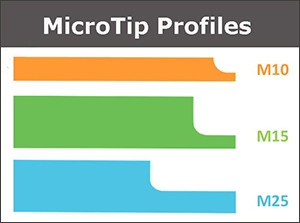
MicroTip Profiles
MicroTip technology offers a range of blade sizes and profiles to optimize metering performance for high viscosity and large particulate formulas. The new MicroTip edge allows the blades to achieve a fine contact area with the anilox roll, delivering a smooth and consistent transfer of coating to the blanket at high press speeds without any spitting or slinging.
Additionally, MicroTip technology offers a range of profiles, including M8, M10, M15, and M25, allowing for customization to achieve a perfect fit for specific applications. To ensure you select the right microtip for your doctor blades, we recommend downloading our microtip selector tool below.
Common Doctor Blade Configurations
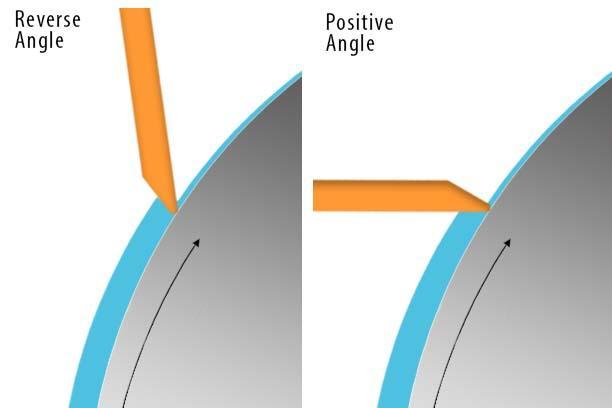
- A positive angle doctor blade is angled in the direction of travel, which means that the blade’s leading edge is higher than the trailing edge. This angle is commonly used in applications where the blade is used to apply a coating or lubricant to a surface.
- A reverse angle doctor blade is angled in the opposite direction of travel, which means that the blade’s leading edge is lower than the trailing edge. This angle is commonly used in applications where the blade is used to remove debris or contaminants from a surface.
Advantages of TruPoint Doctor Blades
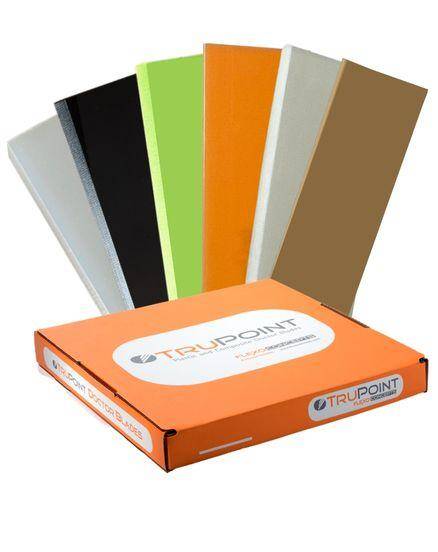
TruPoint doctor blades offer a range of advantages for your roll doctoring and cleaning applications. Our TruPoint blades are engineered and optimized for key attributes like stiffness, creep, metering, and wear. Check out full portfolio of products to find the right doctor blade for your application.